
By Sara Kooperman, JD
Water exercise is often associated with low-impact movement, strength building, and cardiovascular fitness. However, beyond the physical benefits lies an incredible opportunity to develop a mind-body connection that enhances not only performance but also overall well-being. Integrating mindful movement and intentional focus into aquatic workouts helps participants cultivate awareness, improve balance and coordination, reduce stress, and develop a deeper understanding of their bodies.
 What is the Mind-Body Connection?
The mind-body connection refers to the awareness and conscious control of movement, breathing, and posture while engaging in physical activity. It involves being mentally present during exercise, focusing on how the body moves and feels, and responding to physical sensations and cues. Developing this connection improves coordination, balance, and movement efficiency while promoting relaxation and reducing stress. In the context of water exercise, the mind-body connection becomes even more profound. Water’s buoyancy, resistance, and hydrostatic pressure provide a supportive and dynamic environment that encourages mindful movement. By focusing on form, breathing, and sensory feedback, participants can unlock the full potential of their aquatic workouts.
Why is Developing a Mind-Body Connection Important in Water Exercise?
1. Enhanced Movement Control and Efficiency
• Body awareness improves control and efficiency in movement.
• Alignment, posture, and core engagement improve balance and stability in aquatic exercise.
2. Improved Balance and Proprioception
• Water challenges balance by creating constant movement and resistance.
• Subtle position shifts and stabilizing muscles improve proprioception and balance in and out of water.
3. Increased Focus and Stress Reduction
• Mindful breathing and water sensations promote relaxation.
• Mental focus creates a present, immersive experience.
4. Injury Prevention and Body Awareness
• Awareness helps prevent strain and supports safe movement.
• Proper awareness supports safe, efficient movement patterns.
The Role of Instructional Cuing in Building the Mind-Body Connection
Effective instructional cuing is essential for helping participants develop a strong mind-body connection during water exercise. Clear, intentional cuing encourages participants to stay engaged, focus on proper technique, and become more aware of their bodies in motion. Instructors can use a combination of verbal, visual, and kinesthetic cues to enhance movement quality and increase participant awareness.
• Verbal Cues: Use action words and directional cues to guide movement clearly.
• Key Focus Areas: Reinforce core stability, breathing, and proper posture throughout.
• Breath Cues: Sync breathing with movement to support control and relaxation.
• Visual Cues: Demonstrate clear form, range of motion, and smooth transitions.
• Sensory Cues: Encourage awareness of water resistance and body movement.
 Techniques to Develop a Mind-Body Connection in Water Exercise
1. Focus on Breathing and Rhythm
• Begin sessions by connecting breath to movement through slow,
controlled breathing.
• Rhythmic breathing helps maintain pace, reduce tension, and
improve flow.
2. Engage the Core and Visualize Movements
• Engage core muscles to stabilize the body and protect the spine.
• Visualization improves body awareness and movement control.
3. Slow Down and Emphasize Control
• Slow, deliberate movement increases muscle engagement and rang
of motion.
• Moving slowly in water challenges balance and improves coordination.
4. Use Sensory Feedback
• Focus on water resistance and how it affects movement and muscles.
• Pay attention to how position changes impact balance and stability.
5. Practice Balance and Stability Drills
• Use single-leg work, holds, and stability challenges to build control.
• Partner-created water movement increases core engagement and balance demands.
Mind-Body Exercises for Water Workouts
1. Aqua Tai Chi and Yoga
• Slow, flowing movements combined with deep breathing promote relaxation and enhance flexibility.
• These practices improve postural alignment, balance, and mental focus.
2. Mindful Walking and Jogging in Water
• Focus on heel-to-toe movement in water to engage stabilizers and improve body awareness.
• Encourage participants to visualize pushing through the water with each step for improved gait and balance.
3. Core Stability Movements
• Perform exercises like planks, leg lifts, and side kicks with a focus on core activation and controlled movement.
• Emphasize maintaining a neutral spine and engaging deep core muscles to improve stability and balance.
4. Balance and Coordination Drills
• Single-leg balances, dynamic lunges, and rotational movements challenge proprioception and balance in water.
• Use sensory cues and visual focus points to maintain stability and prevent overcorrection.
Incorporating Mindfulness into Water Fitness Programs
Mindfulness techniques can easily be woven into aquatic fitness classes to enhance the mind-body connection. Instructors can:
• Begin sessions with a breathing exercise or body scan to encourage focus.
• Use guided imagery or visualization cues to enhance awareness of movements and posture.
• End sessions with a brief relaxation or gratitude practice to promote mental clarity and reduce stress.
 Who Benefits from Developing a Mind-Body Connection in Water?
1. Older Adults: Improves balance, coordination, and reduces fall risk.
2. Rehabilitation Clients: Enhances neuromuscular control during recovery.
3. Athletes and Fitness Enthusiasts: Refines movement mechanics, preventing injury.
4. Individuals Seeking Stress Relief: Promotes relaxation and reduces anxiety.
Elevating Aquatic Fitness Through Mindful Movement
Developing a mind-body connection in water exercise transforms routine workouts into meaningful, immersive experiences. By encouraging participants to become more aware of their movements, breathing, and balance, fitness professionals can enhance the effectiveness of aquatic workouts while promoting mental and emotional well-being. Integrating mindful cuing techniques into water-based programs empowers participants to move with purpose, build resilience, and experience the therapeutic power of water.

About the Author: Sara Kooperman, JD
Sara Kooperman, JD, CEO of SCW Fitness Education, WATERinMOTION®, and S.E.A.T. Fitness, Founder of the MANIA® Convention, sits on the canfitpro Advisory Panel and the Gold’s Gym Think Tank and was a founding board member for the Women In Fitness Association (WIFA). Recently nominated for the IDEA Fitness Leader of the Year Award, Kooperman won the Most Innovating Fitness Pro by FIT-C (Fitness Industry Technology Council). Sara is the best-selling author of FIT FOR BUSINESS, an inductee into the National Fitness Hall of Fame, an Illinois State Businesswoman of the Year, esteemed panelist for multiple Webinars & Podcasts, and sits on the ACSM Communication & Public Information Committee.
Each year, fitness professionals around the globe have the opportunity to influence the direction of the industry—and that time is now. For the 21st year, the American College of Sports Medicine (ACSM) is conducting its Worldwide Fitness Survey, gathering insights from professionals across commercial, community, clinical, and corporate settings. This widely respected survey identifies the trends that will shape programming, training, and business strategies for the year ahead.
 The results, informed by thousands of industry voices, will be published in the November/December 2026 issue of ACSM’s Health & Fitness Journal®, providing a global snapshot of where fitness is headed. For instructors, trainers, and facility leaders, this is more than a survey—it’s an opportunity to contribute your perspective and help guide the evolution of the industry.
Rather than simply following trends, this is your chance to help define them. Fitness professionals are encouraged to take a few moments to participate and ensure their voice is represented.
Please take a few moments to complete the survey. Take the Survey Here!
By Monica Spagnuolo, Cristina Tandurella, and Stefania Manfredi
For decades, music has been one of the most powerful tools in fitness instruction. In aquatic fitness classes, music helps instructors structure movement, create energy, and maintain rhythm within the group. Tempo guides the intensity of the workout. Musical phrasing supports choreography. The beat becomes a shared reference point for participants and instructors alike. Music is motivating, engaging, and often essential to the atmosphere of a class.
 But what happens when the music stops? For many instructors, silence feels uncomfortable. Music fills the space, supports timing, and helps participants follow the class. Without it, the structure can feel uncertain. Yet removing music can reveal something extremely valuable from a teaching perspective: ATTENTION.
Silence changes the dynamic of a class. Participants begin to listen more carefully, observe more attentively, and feel their own movements in a deeper way. Instead of relying on the beat, they must rely on awareness. This shift opens the door to a different approach to aquatic instruction—one that focuses not only on physical conditioning, but also on learning, coordination, and cognitive engagement.
The Traditional Role of Music in Fitness Programming
Music has always played a central role in group fitness programming. It provides several important benefits:
• It creates motivation and emotional energy
• It supports rhythm and synchronization
• It helps instructors structure choreography
• It maintains group cohesion
In aquatic fitness, these benefits are even more important because participants often rely on visual and auditory cues to follow the instructor in an environment where movement may feel different than on land. However, music can also create predictability. When movements are tightly linked to the beat of the music, participants begin to anticipate what will happen next. This makes the class fluid and enjoyable, but it may also reduce the need for cognitive processing. Participants follow the pattern. The brain works less actively. From a teaching perspective, this raises an interesting question: What if we intentionally create moments where the brain must re-engage?
When Silence Becomes a Teaching Tool
Silence can be surprisingly powerful in a group fitness setting. When music disappears, participants suddenly become more attentive to:
• the instructor’s voice
• visual cues
• their own body sensations
• the surrounding environment
Movements become more deliberate. Instructors can slow down the pace, introduce technical details, and encourage participants to focus on movement quality rather than movement quantity. This approach is particularly effective when working on coordination. Without the constant reference of a musical beat, the nervous system must organize movement differently. Participants must actively process instructions and adapt their motor responses. In other words, they begin to learn, not simply follow.
Coordination and Cognitive Engagement in the Water
Water provides an exceptional environment for coordination training. The resistance of the water slows down movement and provides constant sensory feedback, which helps participants perceive and adjust their actions. This makes aquatic exercise an ideal setting for motor learning. When instructors introduce coordination challenges—such as different arm and leg patterns, changes of direction, or reaction-based exercises—the brain becomes actively involved in the movement process.
This kind of training stimulates:
• neuromuscular control
• reaction time
• motor planning
• cognitive flexibility
For many populations, especially active agers, this integration of physical and cognitive training can be extremely beneficial. But coordination training requires something essential: attention. And attention is easier to cultivate when music is not dominating the environment.
From Silence to a New Teaching Format
These ideas led to the development of a new aquatic training concept called Sound of Silence (SOS). The format is based on a simple but powerful principle: alternating moments of music with moments of silence to create different learning environments within the same class. Music is still present and continues to provide energy and motivation. However, specific sections of the session intentionally remove music to allow instructors to focus on:
• coordination drills
• movement exploration
• body awareness
• cognitive challenges
During these silent phases, instructors can introduce tasks that require participants to listen, observe, and react. For example: Participants might perform a lower-body movement while the instructor assigns different arm patterns through verbal cues. They may respond to visual signals that change direction or tempo. They may perform mirror exercises with a partner. Without music guiding the rhythm, participants must rely on perception and reaction. This creates a deeper level of engagement.
A Different Experience for Participants
Participants often describe silent segments as surprisingly intense—not physically, but mentally. They become more aware of their movements, more attentive to the instructor, and more connected to the group dynamic. When music returns, the contrast creates a renewed sense of energy. The class becomes a dynamic journey between movement, learning, and awareness.
 Expanding the Role of the Aquatic Instructor
The Sound of Silence approach invites instructors to expand their role beyond leading choreography. Instructors become facilitators of learning experiences. They guide participants through moments of rhythm and moments of reflection, moments of energy and moments of concentration. This balance allows aquatic fitness to evolve into something even more powerful: a training experience that stimulates both body and mind. In a world where music is constant and noise is everywhere; silence may become one of the most valuable tools an instructor can use. Sometimes, when the music stops, the real learning begins. Want to Learn More? The Sound of Silence (SOS) format was developed to help aquatic instructors integrate coordination, motor learning, and cognitive engagement into their classes. If you are interested in exploring this approach or would like more information about the method, feel free to contact us at www.aquaclasses.com. Workshops, educational materials, and training opportunities are available for instructors who want to expand their teaching tools in the water.

About the Author: Monica Spagnuolo
Monica Spagnuolo is the inventor of Acquapole® and co-creator of the training protocols and the Aquaclasses platform.

About the Author: Cristina Tandurella
Kathleen Haden, MBA, is a Cristina Tandurella has a degree in Physical Education and Adaptive Activities. She is an international presenter of Aguamovida Fitness® and specializes in massage therapy and functional rehabilitation.
By Sara Kooperman, JD
Aqua instructors are among the most dynamic professionals in the fitness industry. Teaching in the water requires endurance, coordination, and sustained energy—often across multiple classes per day. Yet, nutrition is frequently overlooked as a key component of performance and longevity. What you eat directly impacts how you move, cue, lead, and recover.
 Pre-Class Fuel: Stabilizing Energy
Teaching without proper fuel often results in low energy and poor focus, while heavy meals too close to class can feel uncomfortable in the water. The goal is to maintain stable blood sugar through balanced nutrition that combines carbohydrates for quick energy and protein for sustained support. At the SCW Nutrition Coaching Summit, sessions such as Glucose Regulation Essentials and How Blood Sugar Works, presented by Kelli Calabrese, MS, RDN, explore how stabilizing blood sugar can improve energy, mood, and performance—critical for instructors teaching multiple classes throughout the day.
Recovery: The Missing Link
Many instructors move from one class to the next without properly refueling, which can lead to cumulative fatigue and decreased performance over time. Recovery nutrition plays a vital role in muscle repair, energy replenishment, and long-term performance. Sessions like Endurance Fueling: Facts vs. Fiction and Art of Food as Fuel, presented by Dana Angelo White, MS, RD, ATC, provide practical, science-based strategies to support recovery, improve endurance, and sustain performance throughout demanding teaching schedules.
Nutrition for Active Aging and Joint Health
Aqua instructors frequently work with active aging populations, making nutrition education particularly valuable. Supporting muscle maintenance, bone health, and joint function becomes increasingly important as clients age. The SCW Nutrition Coaching Summit addresses these needs through sessions such as SA4B: Nutrition for Healthy Aging (NEW) with Gregory Charlop, MD, which explores how nutritional needs evolve and how to support strength, vitality, and longevity. Joint health is another key focus area. In SA3B: Nutrition Strategies for Arthritis (NEW), Christine Conti, MEd, provides evidence-based approaches to reducing inflammation and supporting movement, helping instructors guide clients toward improved function and consistency.
Supporting Women Through Menopause
A large percentage of aqua participants are women navigating perimenopause and menopause, making this an essential area of focus for instructors. Sessions such as SA2B: Nourish Through Menopause (NEW) with Dr. Kella Price, MS, EdD, and SA5B: Sustainable Nutrition for Menopause (NEW) with Amber Toole, focus on practical, sustainable strategies to support hormonal balance, manage symptoms like fatigue and brain fog, and promote long-term lifestyle change. These insights allow instructors to better understand and support this population with confidence.
The Mind-Body Connection
Nutrition is not just physical—it directly impacts mental clarity, mood, and confidence. When instructors are properly fueled, their cueing is sharper, their energy is more consistent, and their presence is stronger. Sessions like Fueling Fitness – Food Meets Mood and Sugar & the Mind-Body Connection, presented by Dr. Melissa Morris, PhD, explore how nutrition influences mental performance, helping instructors better manage their own energy while also supporting their participants.
 Elevate Your Expertise at the SCW Nutrition Coaching Summit
The SCW Nutrition Coaching Summit brings together leading experts to deliver practical, science-based strategies that fitness professionals can immediately apply. With sessions led by Kelli Calabrese, Dana Angelo White, Gregory Charlop, Christine Conti, Dr. Kella Price, Amber Toole, and Dr. Melissa Morris, the Summit covers critical topics including blood sugar regulation, recovery, aging, menopause, inflammation, and performance nutrition. This comprehensive approach provides instructors with the tools needed to enhance both their own performance and the experience of the clients they serve.
Final Thought
As an aqua instructor, your body is your business—and your knowledge is your value. When you combine smart fueling with effective programming, you not only improve your own performance, but also elevate the experience for every participant you lead.

About the Author: Sara Kooperman, JD
Sara Kooperman, JD, CEO of SCW Fitness Education, WATERinMOTION®, and S.E.A.T. Fitness, Founder of the MANIA® Convention, sits on the canfitpro Advisory Panel and the Gold’s Gym Think Tank and was a founding board member for the Women In Fitness Association (WIFA). Recently nominated for the IDEA Fitness Leader of the Year Award, Kooperman won the Most Innovating Fitness Pro by FIT-C (Fitness Industry Technology Council). Sara is the best-selling author of FIT FOR BUSINESS, an inductee into the National Fitness Hall of Fame, an Illinois State Businesswoman of the Year, esteemed panelist for multiple Webinars & Podcasts, and sits on the ACSM Communication & Public Information Committee.
Who says you need a pool to make waves? SCW Fitness has your aqua exercise education covered whether you are splashing in a pool or learning on the deck. From in-person conventions to immersive virtual summits, you can stay current on research, programming, and performance—on your schedule.
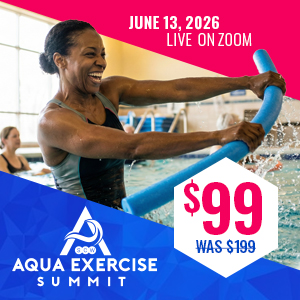
 Aqua Pros, mark your calendars for the all-new Aqua Ex Summit, Saturday, June 13, on Zoom. Let SCW bring the pool to you. The schedule isn’t up yet, but registration is open. Save $100 with the early-bird price and pay as little as $99. Choose from 24 live-streamed sessions and 36 recorded workshops that you can watch for 60 days from anywhere with the All-Access pass.
If you prefer to rub elbows with rockstars in the Fitness Industry and experience a real-time connection, then fuel your passion at Florida MANIA®, May 29–31, at the beautiful Caribe Royale Orlando. With 200+ workshops and lectures, including a whole room and pool devoted to learning the latest aquatic education, you’ll gain practical skills you can apply immediately. Earn 20+ CECs/CEUs while learning from top Water Fitness leaders, exploring the latest trends, and networking with passionate health and wellness pros from across the country—all in one high-energy, immersive weekend.
Take your wellness coaching to the next level with the Nutrition Coaching Summit, May 16–17, a fully virtual event dedicated to one of the most in-demand areas in health and fitness. Choose from 36 sessions covering nutrition science, behavior change, recovery, sleep, and sustainable wellness strategies. Perfect for trainers and coaches looking to deepen client impact and expand their services.
 The education continues throughout the year with additional in-person opportunities including Atlanta MANIA, Dallas MANIA, Midwest MANIA, and Boston MANIA—each offering diverse sessions, industry networking, and continuing education credits.
From virtual summits to in-person intensives, SCW offers education that fits your schedule and learning style. Plus, with recording options available for every event, you can earn CECs/CEUs anytime, anywhere—on your terms.
From Florida to your living room, SCW Fitness is here to keep you inspired, educated, and ahead of the curve in 2026.
By Matthew Solan – Harvard Men’s Health Watch
Balance is something you take for granted until it fails you. If stumbles have become more frequent, even if you’ve escaped with only a jolt of adrenaline or a minor knee scrape, they could be a wake-up call that your balancing skills need attention.
 “As you age, balance becomes even more essential, and you should approach it like any other part of your fitness,” says Kaitlyn Buckwell, a strength and conditioning specialist with the Center for Sports Performance and Research at Harvard-affiliated Mass General Brigham. “Strong balancing skills not only can protect you from falling, but they can also reduce the likelihood of a severe injury if you do.”
Four-stage balance test
How can you tell if your balance is unbalanced? Take the four-stage balance test, a simple baseline assessment used by physical and occupational therapists to evaluate balance and an individual’s risk of falling. The test measures how long you can stand in a series of positions. Each stance is harder than the one before. “The goal is to maintain balance for at least 10 seconds without needing support before advancing to the next stance,” says Buckwell. Perform the tests barefoot, keeping your arms at your sides or extended out, and your gaze straight ahead. “Do them near a wall, chair, or another person in case you do lose your balance,” says Buckwell.
Side-by-side. Stand on a flat surface with your feet positioned next to each other so they touch. Hold the position without moving your feet.
Semi-tandem. Place the instep of the arch of one foot so it’s next to and touching the big toe of the other foot. Hold the position without moving your feet. Switch foot positions and repeat.
Tandem. Place one foot in front of the other, so the heel and toes touch. Hold the position without moving your feet. Switch foot positions and repeat.
Single-leg. Stand with your feet hip-width apart, hands on your hips. Lift one foot off the floor to about mid-calf height. Hold this position for 10 seconds, or until the raised foot touches the ground or you lose your balance. Switch foot positions and repeat.
What do the results mean? If you can’t hold the tandem or single-leg for 10 seconds (or if you can’t progress to the tandem stance at all), you are at high risk of falling, and you should see a physical therapist for further evaluation, according to Buckwell. “They can help you improve your balance through exercises that increase joint stability, mobility, and strength.”
Advanced balance tests
Even if you easily pass the four-stage balance test, your balancing skills still may need attention. “More advanced tests can gauge your balance and coordination during everyday movements, when you are most likely to stumble or fall,” says Buckwell. Here are three tests she recommends. “All these tests also act as balancing exercises. Practicing them regularly not only helps monitor your balance skills, but also improves them.”
Single-leg variations. Variations of the single-leg test are a good measure of overall balance and can assess how well you maintain stability on a single support. “One-leg standing – that is, shifting most of your weight to one leg – is something we do every day, although we may not notice it, such as when we’re walking, stepping off a curb, or climbing stairs,” says Buckwell. Retake the single-leg test on each leg, only this time hold the pose for as long as possible. In general, adults ages 65 and older should aim for 10 to 30 seconds. “Being able to stand on one foot for close to 30 seconds is a sign of good balance,” says Buckwell. Be aware that the balancing times may vary slightly between the right and left legs. “We often have a dominant leg just like a dominant hand, so you may find that one leg is weaker than the other and can’t hold the balance as long,” says Buckwell. “This can help identify if you have a muscle imbalance that needs attention.” If you can hold the pose for longer than 30 seconds, make it more challenging. For instance, close your eyes while holding the pose, stand on a foam pad instead of the floor, or reach for an object on a nearby table or on the floor.
 Heel-to-toe walking. This test gauges your balance, coordination, and body awareness as you walk. Assume the tandem standing position: one foot in front of the other, the heel and toes touching, arms to the sides or extended out. Gazing straight ahead, walk heel-to-toe as if you’re on a tightrope for 10 steps, then turn around and walk back to the starting point. The goal is to complete the test in 20 seconds or less. “Slower times may indicate a lack of balance and increased risk of falls,” says Buckwell.
Timed up and go (TUG). TUG assesses functional mobility and fall risk. From a seated position, stand and walk in a straight line at a normal pace for 10 feet, turn around, walk back, and sit down. “Generally, you want to complete the test in 12 seconds or less,” says Buckwell. “Times over 12 seconds may indicate a higher risk for falls.”
Special thanks to Harvard Health Publishing for publishing this article. You can view the original post here: A measure of balance.

About the Author: Matthew Solan
Matthew Solan is the former executive editor of Harvard Men’s Health Watch. He previously served as executive editor for UCLA Health’s Healthy Years and as a contributor to Duke Medicine’s Health News and Weill Cornell Medical College’s Women’s Nutrition Connection and Women’s Health Advisor. Matthew’s articles on medicine, exercise science, and nutrition have appeared in Men’s Health, Men’s Fitness, Muscle & Fitness, Runner’s World, and Yoga Journal. He earned a master of fine arts in writing from the University of San Francisco and a bachelor of science in journalism from the University of Florida.
 Fresh, light, and easy to transport, this colorful dish holds up well in warm weather and is packed with plant-based protein and fiber. It’s refreshing, travel-friendly, and tastes even better after sitting for a bit—perfect for a post pool gathering.
Ingredients
• 1 cup quinoa, cooked and cooled
• 1 can chickpeas, rinsed and drained
• 1 cup cherry tomatoes, halved
• 1 cucumber, diced
• ½ cup shredded carrots
• ¼ cup chopped fresh parsley
• 2 tbsp chopped fresh mint
• Zest and juice of 1 lemon
• 2 tbsp olive oil
• 1 tsp honey (optional)
• Salt and pepper to taste
Optional: crumbled feta or diced avocado
Directions
1. In a large bowl, combine quinoa, chickpeas, tomatoes, cucumber, carrots, parsley, and mint.
2.Whisk lemon juice, zest, olive oil, honey, salt, and pepper.
3. Toss everything together until well coated.
Chill before serving and garnish with feta or avocado if desired.


Sound of Silence: When Music Stops
and Learning Begins Rethinking the Role
of Music in Aquatic Fitness